
ContextCollab
Shared Context Workspace for Faster Team Decisions
Event:
Microsoft GitHub Copilot Hackathon * NYC Tech Week
Year:
2026
Role:
Team Collaboration / System Design / Vibe Coding
Stack:
Next.js 15 / React 19 / Ably / OpenAI API
Type:
Hackathon Product / AI Collaboration Tool
Repository
georgeisgreat/June04Hackathon
View GitHub
Prototype code for ContextCollab from Microsoft GitHub Copilot Hackathon * NYC Tech Week.
ContextCollab is a hackathon product built around a tension every AI-assisted team feels: people want private, exploratory AI conversations, but teams still need a way to share only the useful parts. The app keeps each collaborator's private chat local by default, then lets them intentionally push selected context into a realtime shared branch.
The goal is not to expose everyone's entire prompt history. It is to create a privacy-aware collaboration layer where teammates can preserve their own thinking space while still pooling key discoveries, summaries, and reusable context.
During Microsoft GitHub Copilot Hackathon * NYC Tech Week, the team prototyped a browser-based workflow with two clients, private chat panes, a shared context branch, invite-link collaboration, and realtime fanout using Ably. OpenAI API calls power private responses, shared AI responses, summarization, and pull-context behavior.
The page below documents the shipped UX, the technical architecture, and the in-room hackathon moments behind the prototype.
Problem
Useful AI context gets trapped in private chats.
Team members discover answers separately, then lose time re-explaining or copy-pasting fragments across channels.
Solution
Selective sharing from private to shared.
Users keep private chat history private, select only relevant messages, summarize them, and push shared context cards to the team.
Outcome
Team context without oversharing.
Collaborators can pull selected shared context back into their own AI chat and continue working from a common base.
Prototype Flow
The prototype flow keeps privacy as the default, then makes collaboration explicit. A user chats privately with Copilot, selects the messages worth sharing, summarizes and pushes them into a shared branch, and teammates can pull that shared context into their own private thread.
1. Chat Privately
Each browser client keeps its own local private messages and AI responses.
2. Select Context
Users choose the exact private messages that are useful enough for team sharing.
3. Summarize & Push
The app summarizes selected context and publishes shared cards to the room.
4. Pull & Continue
Collaborators pull shared context into their own private chat and keep working.
UX and Technical Architecture
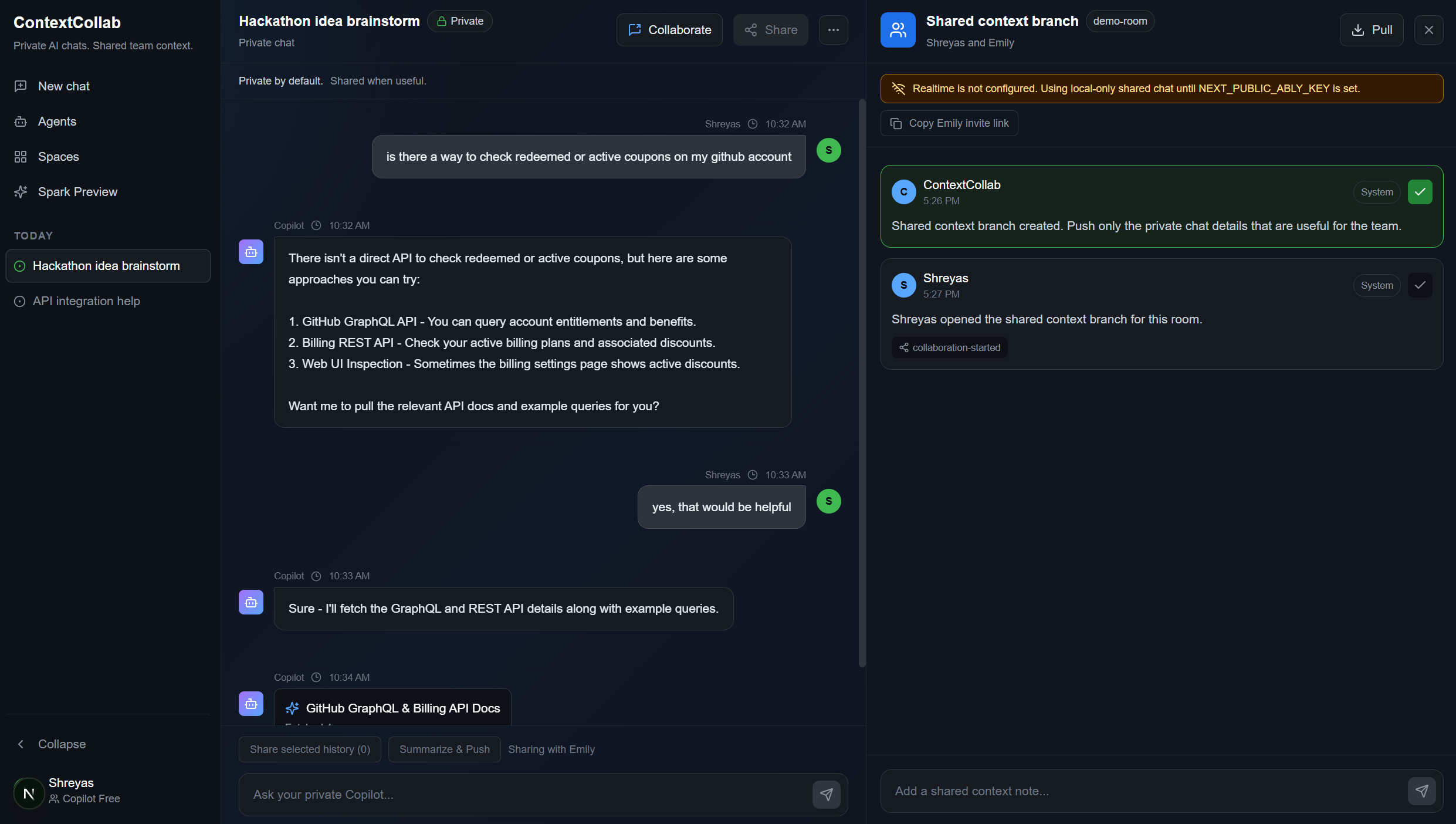
Prototype UX - private chat on the left, shared context branch on the right
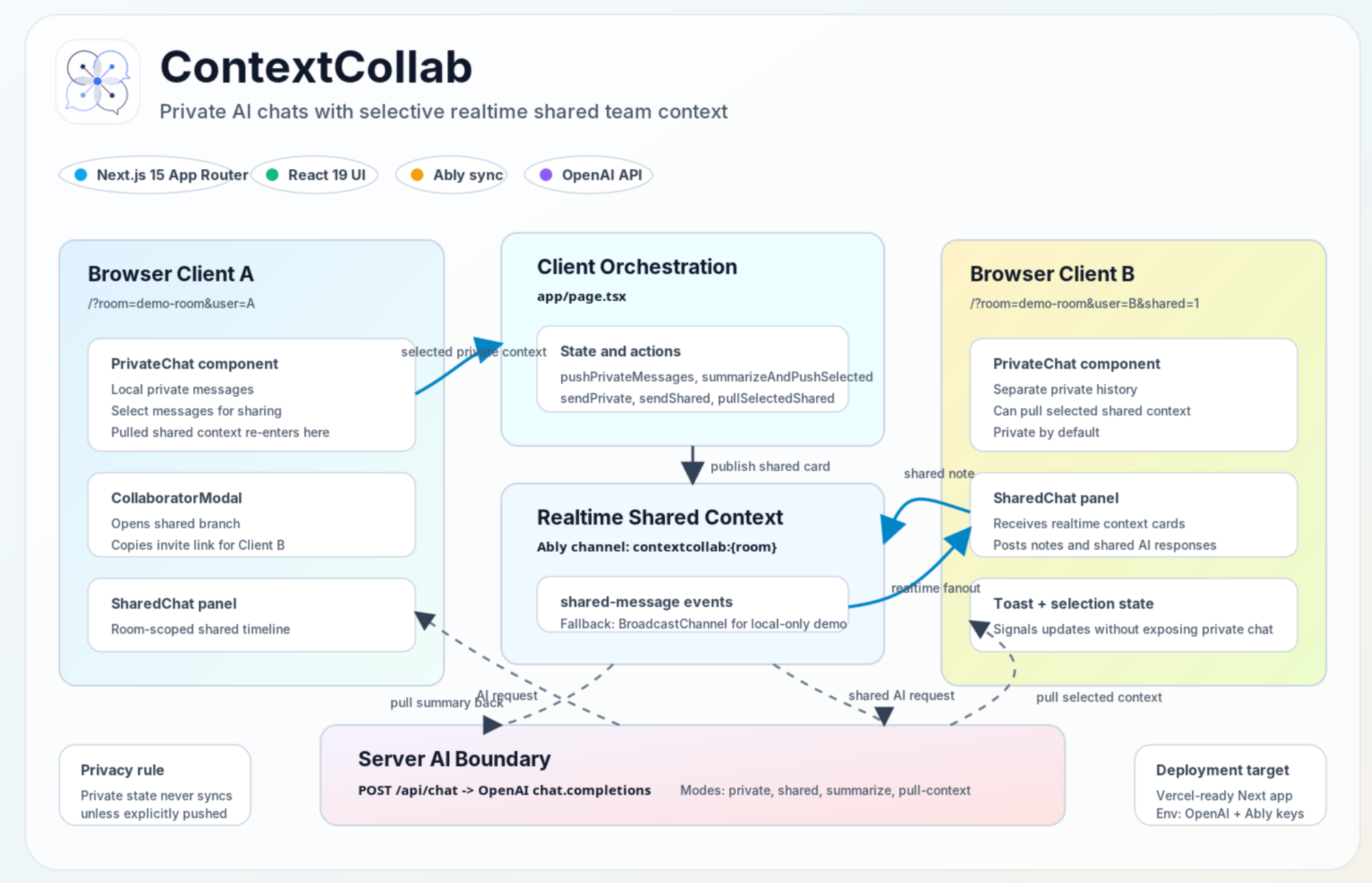
Tech stack - Next.js 15 App Router, React 19 UI, Ably sync, OpenAI API
Key Features
- Private chat as the default workspace for exploratory AI conversations.
- Selective sharing controls so users decide exactly which private context becomes team context.
- Realtime shared context branch scoped by room and powered by Ably sync.
- Summarize-and-push workflow that turns selected messages into compact shared cards.
- Pull-context action that lets collaborators bring shared context back into their own private chat.
Team Collaboration
- Collaborated as a team to define the core product idea: private AI chats with selective realtime shared context.
- Discussed and refined the feature set together, including private chat, shared context branch, invite links, summarize-and-push, and pull-context behavior.
- Worked through the system design together across browser clients, shared room state, OpenAI response modes, and Ably realtime sync.
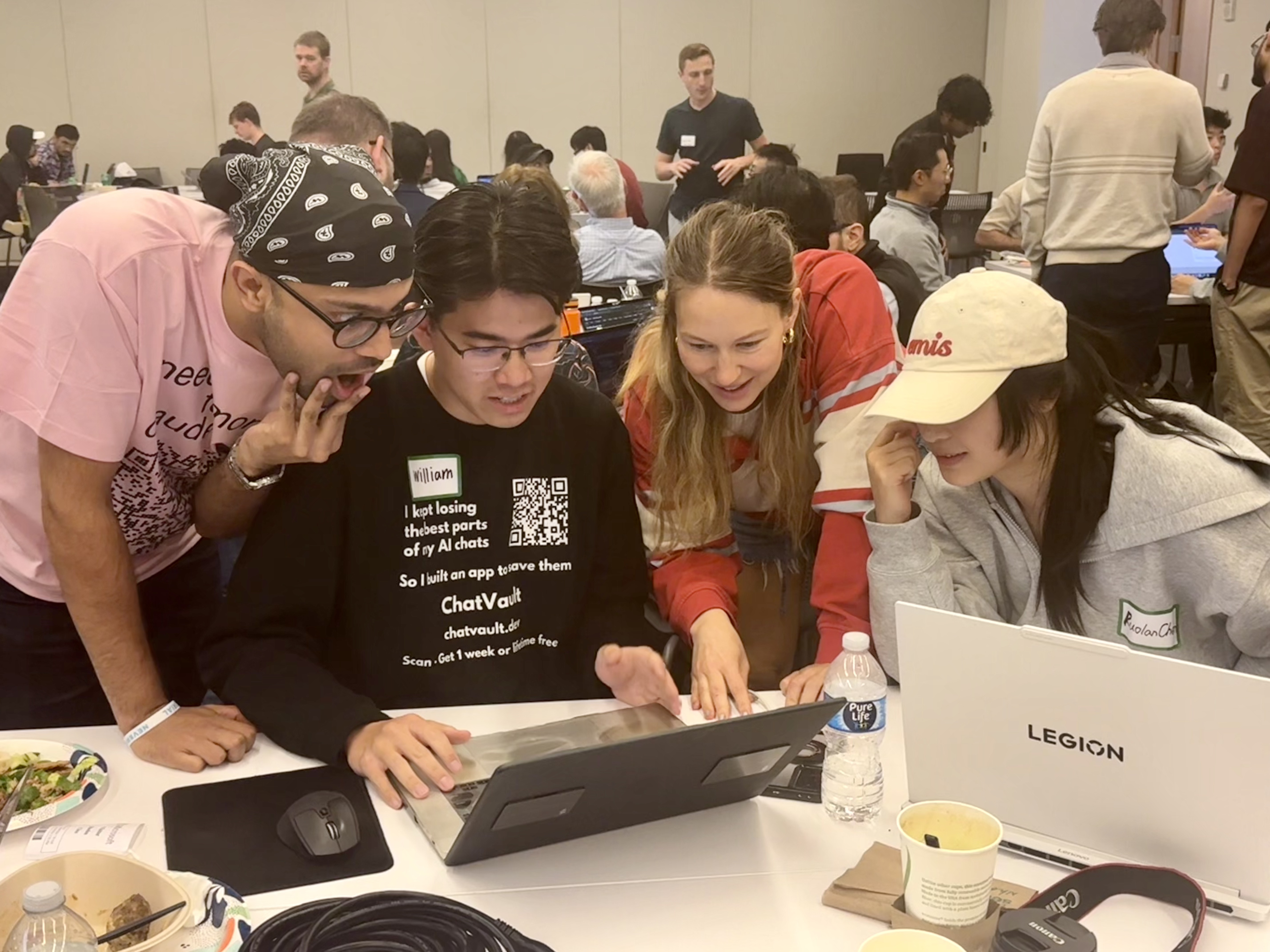
- Vibe coded the prototype collaboratively during the hackathon, moving quickly between UX decisions, implementation, testing, and demo polish.
- Prepared the case-study framing after the hackathon to document the team's product thinking and build process.
Hackathon Moments
Working session during Microsoft GitHub Copilot Hackathon * NYC Tech Week
What I Would Build Next
The next iteration would focus on stronger realtime collaboration and permission controls: persistent rooms, authenticated invite links, granular shared-card visibility, better conflict handling between local and Ably-backed sync, and evaluation hooks so teams can mark whether shared AI summaries were useful, incomplete, or misleading.
Acknowledgements
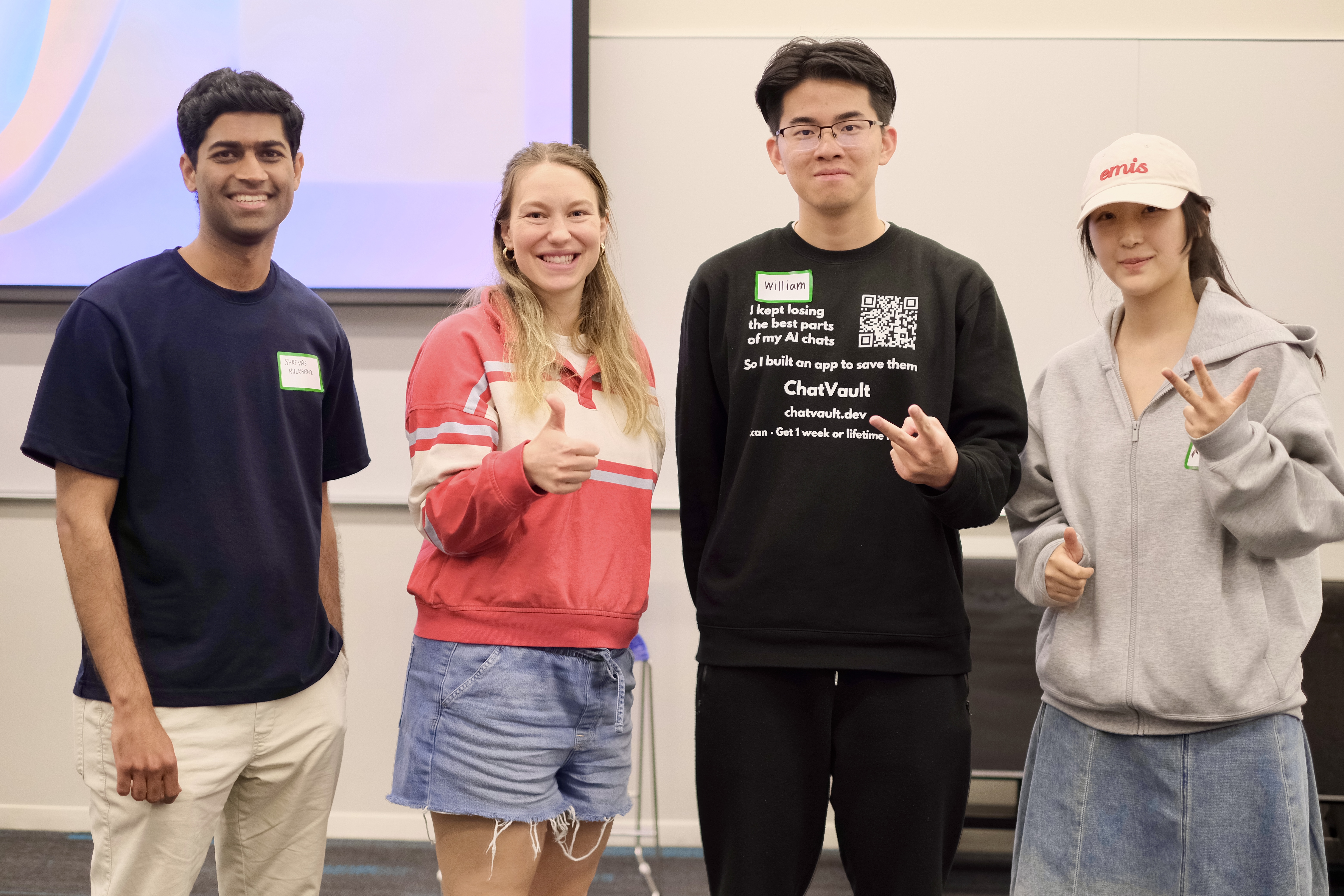
Great building alongside the ContextCollab team: @Shreyas Kulkarni, @William Liu, @Emily Simmons, and @Joshua Solomon.